It was December and my Protestant Church was having a ladies Christmas party. The speaker was our very own admissive pastor and I was excited to hear what she would have to say. She was always so kind to me and helped me get through some hard times. My mom called me and my sisters over and whispered, “She has breast cancer, and it might come up in her talk.”
That horrible c-word had found me again. I had learned about the different saints that the Catholic Church has. So I grabbed my phone and searched for a saint that could help. Saint Agatha came right up. I then went over to Amazon and ordered a metal and prayer card.
After the talk I went up to her and told her that I was going to give he something. The following Sunday I brought a small gift bag that had a blessed metal and prayer card. I had learned the basics of this saint. I gave her the bag and she cried because of how thoughtful the gift was.
Story
Agatha lived in the 3rd century (c. 231–251 AD) in Sicily, likely Catania. She was born into a wealthy Christian home. Her family might have had some estates and some money. This is why Quintianus wanted to marry her on top of her beauty. More on Quintianus later. But we don’t know a lot about her really life.
She was very beautiful and piteous. Agatha dedicate herself to the Church at a very young age. By age 15, she had already taken a vow of virginity. This made her a consecrated virgin and spoused to Jesus Christ. Her vow is symbolized in art with a flammeum or a red veil. At that time most woman got married around 12 and 15.
Agatha had many suitors and one of them was called Quintianus. Now Quintianus was a Roman prefect who wanted Agatha for her beauty and her wealth. She kept rejecting his advances. Quintianus got tired of Agatha saying no, so he used the the anti-Christian edicts of Emperor Decius to have her arrested.
Before Agatha was tortured she was sent to a brothel to try to break her will and vow. Quintianus handed Agatha over to a woman named The Procuress Aphrodisia. Aphrodisia ran a brothel with her nine daughters. The goal was to use a month of assault, humiliation, and "sinful" surroundings to corrupt Agatha’s spirit and make her more compliant. After a month Aphrodisia sent a report to Quintianus stating that it was easier to "soften stones" than to change Agatha's mind.
Quintianus became enraged so he moved Agatha from the brothel to a prison cell. Since she was staying at the brothel during her trail instead of being in a jail cell. During this trail Quintianus mocked her for living like a lowly "servant" of Christ despite her high birth, she famously replied:
"I am a handmaid of Christ, and that is why I bear the outward appearance of a slave; for the highest nobility consists in being a slave to Christ."
Quintianus then subjected Agatha to horrific tortures. Most famously, he ordered her breasts to be cut off, but he also used the rack on her. Legend says that after her breasts were cut off, St. Peter the Apostle appeared to her in a vision and miraculously healed her wounds. Quintianus was not moved by Agatha’s healing. He became even more enraged at her healing.
Four days after her healing, Agatha was brought back to the tribunal. When she continued to refuse to sacrifice to the Roman gods, Quintianus ordered a final, brutal punishment. I can almost imagine that as Quintianus told Agatha the final punishment he mixed in a few other words. I also hear him sneering and mocking as he says, “I will save you if you would just marry me and offer sacrifices to the gods.” With her final refusal Quintianus gave the order.
Agatha was taken to a bed of live burning coals with sharp potsherds or broken pieces of pottery. Agatha was stripped naked, but she kept her veil with her. She was then rolled over the coals and broken pottery until Quintianus got scared of the crowd. Her veil, according to legend, didn’t burn.
Quintianus, as I said before, got scare of the crowd that was watching Agatha get rolled over the coals. So he ordered that she be sent back to her prison cell. Her final prayer was recorded and was:
“Lord, my Creator, you have protected me from the cradle; you have taken me from the love of the world and given me patience to suffer. Receive now my soul." Saint Agatha’s final prayer.
After her final prayer she died on February 5, 251 AD. Tradition adds a bit of "poetic justice" for Quintianus. Shortly after Agatha’s death, he set out to seize her family's lands. While crossing a river, his horse reportedly bit and kicked him, knocking him into the water, where he drowned and his body was never found.
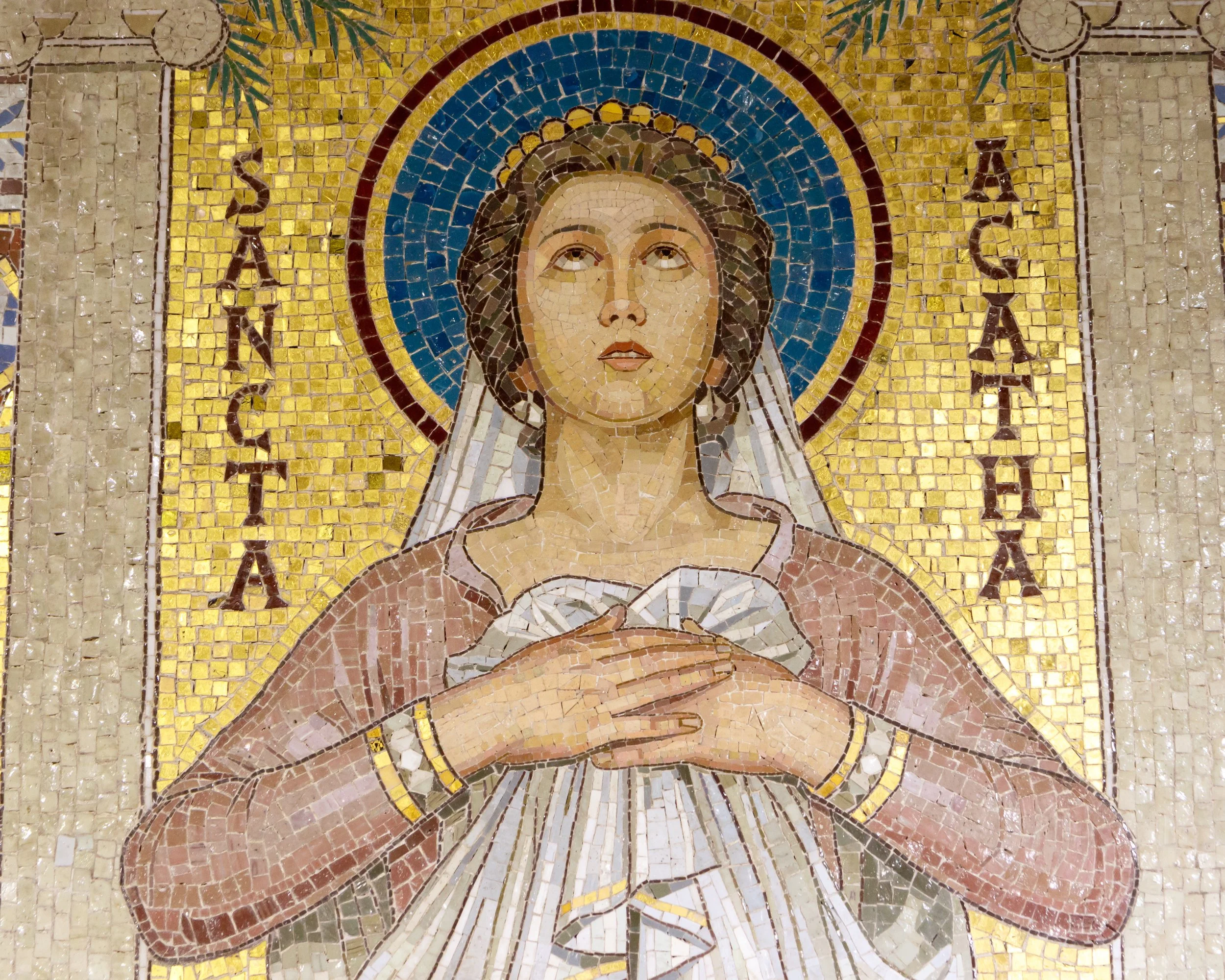
Saint Agatha
If you read my How to Become a Saint then you know that Agatha became a Blessed after her death. She needs at least one miracle to prove that she is in heaven before she can become a saint. When it comes to saints the end is not always the end.
One year after her death, Mount Etna erupted violently, threatening the city of Catania. The locals took Agatha’s burial veil and used it to face the lava flow. According to accounts, the lava stopped immediately. To this day, she is considered the primary defender of Catania against the volcano.
The full story about the miracle is pretty cool. So I will tell the whole story. Her veil didn’t burn when she was rolled over the coals. After her death, this veil was preserved by the Christians of Catania as a sacred relic, believed to carry the "spirit" of her protection. The veil’s reputation was solidified exactly one year after her death. In 251–252 AD, Mount Etna erupted with terrifying force. A massive "river of fire" (lava) descended toward the city of Catania.
The panicked citizens—including many pagans who had witnessed her martyrdom—ran to Agatha’s tomb. They took the silk veil that covered it and carried it to the edge of the advancing lava flow. Tradition holds that the moment the veil was held up against the fire, the lava flow stopped in its tracks.
This event is why she is the Patron Saint against fire and volcanic eruptions. To this day, the people of Catania credit her for the city's survival through dozens of subsequent eruptions. Which is super cool. On a more science note… Mount Etna is a stratovolcano, known for both "effusive" (slow-moving lava) and "explosive" eruptions. Its proximity to Catania has shaped the city's architecture and its faith.
There is a small debate about a White Veil vs. a Red Veil. While the relic itself is often described as reddish (the color of a martyr), some legends say the veil was originally white but turned red when it came into contact with the fire/lava, absorbing the "heat" to protect the city. Which is also cool. My thought on the matter is that this happened so long ago we will not know all of the details. I am okay with that. Even in modern times, when Etna erupts, it is common to see processions. In 1886, the veil was again carried to the village of Nicolosi; the lava flow stopped, and a shrine was built on that exact spot.
So how was Agatha sainted? This was back when there was no formal process, like what we see today. She was so widely accepted as a saint that she was just made a saint in the Roman Canon. Her sainthood was formally recognized and confirmed by Pope Gregory I (Gregory the Great) in the 6th century. He even re-dedicated a church in Rome in her honor (Sant'Agata dei Goti) around that time.
Feast Day
Saint Agatha’s feast day is February 5. So how do we celebrate this amazing woman and her courage? If you visit Catania today, you will see the importance of this history everywhere. Her feast day (February 3–5) is one of the largest religious festivals in the world. Her relics, including the veil, are placed in a massive silver carriage (the fercolo) and pulled through the streets by thousands of "Cittadini" (citizens) wearing white tunics. Massive, ornate wooden candles are carried to represent the different guilds of the city, symbolizing the light that Agatha brought to the "darkness" of the volcano’s ash. But Catania might be to out of reach for us today. So how do we celebrate?
The easiest way to celebrate is with traditional sweets. These sweets are called Minne di Sant'Agata (Saint Agatha's Breasts). They are small, dome-shaped cakes made of sponge cake soaked in liqueur, filled with ricotta, chocolate chips, and candied fruit. They are covered in white icing and topped with a single candied cherry. These cakes do look like breasts. Another sweet that is common is Olivette di Sant'Agata. These are small, olive-shaped sweets made of green almond paste (marzipan) and rolled in sugar. These represent a legend where an olive tree miraculously grew to provide Agatha with food and shade while she was hiding from Roman soldiers. I will need to look into that miracle. Maybe next year.
Another way to celebrate Saint Agatha is to focus on fire safety. Use this day as your annual reminder to change the batteries in your smoke and carbon monoxide detectors. You can even practice a family fire drill. In some traditions, "Agatha loaves" are baked and blessed by a priest. These loaves were historically kept in the home to protect the household from fire and famine.
You can also pray for health. As the patroness of those suffering from breast cancer and diseases of the breast, many people offer special prayers or light a candle for loved ones facing these health battles. If you attend Mass, listen for her name; she is one of the few women specifically mentioned in the First Eucharistic Prayer.
Making Minne di Sant'Agata
Making Minne di Sant'Agata at home is a fun (and delicious) way to honor her story. These are essentially miniature "cassata" cakes. While the traditional version involves sponge cake and marzipan, this is a simplified version using a shortcrust pastry base that is much easier to handle.
Ingredients:
For the Pastry (The Shell):
2 cups All-purpose flour
1/2 cup Sugar
1/2 cup Cold butter (cubed)
1 Egg + 1 Egg yolk
Pinch of salt
For the Filling:
1 cup Ricotta cheese (drained well)
1/3 cup Powdered sugar
1/4 cup Mini chocolate chips or candied fruit (optional)
For the Topping:
2 cups Powdered sugar
2–3 tbsp Lemon juice or water
Candied cherries (for the top)
Instructions
Make the Pastry: Mix the flour, sugar, and salt. Rub in the cold butter until it looks like crumbs. Add the egg and yolk, and knead quickly until a dough forms. Wrap it and chill in the fridge for 30 minutes.
Prep the Filling: While the dough chills, whisk the ricotta and powdered sugar together until smooth. Fold in your chocolate chips or candied fruit.
Assemble the Domes: * Roll out the dough and cut circles (about 3–4 inches wide).
Place the circles into a greased muffin tin or semi-sphere molds.
Drop a spoonful of the ricotta mixture into each.
Place another, slightly smaller circle of dough on top and pinch the edges to seal them shut.
Bake: Bake at 180°C (350°F) for about 20–25 minutes or until lightly golden. Let them cool completely before removing them from the pan.
The Glaze: Mix the 2 cups of powdered sugar with lemon juice one tablespoon at a time until you have a thick, white, pourable icing.
The "Cherry on Top": Place the cooled cakes on a wire rack. Pour the white icing over each one so they are completely covered. While the icing is still wet, place one candied cherry right in the center of the dome.
In Sicily, these are often served chilled. If you want to be extra authentic, you can brush the inside of the pastry with a little bit of Maraschino liqueur or orange blossom water before adding the ricotta.
This is a simple recipe that I had Google Gemini help me find.

Minne di Sant'Agata
This is how my Minne di Sant'Agata turned out. I had some trouble with the icing. But they turned out really good. I will have to make them again next year.
Peddling
I am an Amazon Affiliate, so I might get money for any links that are clicked. So here are some things that I found. The first one is the necklace and prayer card that I got my friend.
St. Agatha Novena: Biography, Legacy, Suffering, Trials, Reflections, 9-Day Powerful Devotion Prayers to the Patron Saint of Sicily, Breast Cancer Patients & Wet Nursesp (Miracles in Prayer) by FR James Benedict
Giftware by Roman, St. Agatha Figurine 3.5" - Figurine Santo Saints Confirmation
A Detailed biography of St Agatha of Sicily: Biography and a powerful Catholic novena Prayers to the Patron st of Breast cancer patients, and nurses. (Devotional catholic prayer books) by Rev Spencer W. Nicholson
I am praying for you. Please, pray for me and my little blog. If you have anything that you would like me to pray for feel free to use the comment section. Just remember to be nice to each other.
References
Primary Historical Sources (The "Passio")
The details of Agatha’s life come from several versions of her Passio (The Account of the Passion). These were written several centuries after her death but are based on earlier oral and written traditions.
The Latin Passio (approx. 5th-6th Century): The most common source used in Western Christianity. It details the dialogue between Agatha and Quintianus and the specific tortures she endured.
The Greek Passio: Similar to the Latin, but often emphasizes her connection to the city of Palermo. This version was widely used in the Byzantine Empire.
The Acts of the Martyrs: Compiled accounts of early Christian victims of Roman persecution. Agatha is consistently listed alongside other early martyrs like St. Agnes and St. Lucy.
Ancient Liturgical References
Agatha’s name appears in the earliest records of the Church’s official worship, which proves her cult was established very early.
The Roman Canon (1st Eucharistic Prayer): Dating back to the early centuries of the Church, Agatha is one of only seven women (excluding the Virgin Mary) mentioned by name in the central prayer of the Mass.
Martyrologium Hieronymianum: An ancient list of martyrs attributed to St. Jerome (c. 450 AD), which confirms her feast day as February 5th.
The Gelasian Sacramentary: One of the oldest books of Roman liturgy, which contains specific prayers for her feast.
Archaeological & Geographic Evidence
Physical evidence in Sicily and Italy provides a tangible link to her history.
The Tomb in Catania: Located in the Church of Sant'Agata la Vetere. This is believed to be the site of her original burial.
The Reliquary and Veil: Housed in the Cathedral of Saint Agatha (Duomo di Catania). The silver reliquary bust dates to 1376, but the veil inside is an ancient silk fabric consistent with the period.
Sant'Agata dei Goti (Rome): A church dedicated to her in the 5th century by Ricimer. Its mosaics and inscriptions serve as a historical reference to her widespread veneration in the early Middle Ages.
