Saint Basil the Great will be the first hero of the faith that I will talk about. I choose to talk about this saint first for two reasons. The first is that Saint Basil’s feast day was January 1st or 2nd. It was last week. I also choose him because he is seen as a saint by the Roman Catholic Church and the Orthodox church. I will go over the life of Saint Basil and how to celebrate his feast day.
Life and Death
Early Life
Basil was born around 330 AD in Caesarea (modern-day Turkey) into what might be the most "holy" family in history. Almost every member of his immediate family is a canonized saint. It almost reminds me about Saint Thérèse of Lisieux, she also has a family of mostly canonized saints, or at least her parents were. I will write about her in the future, and look into the matter more.
Basil’s family members who were canonized included his grandmother, Macrina the Elder. She survived the Roman persecutions and taught Basil the faith. Which reminds me about the good holy women in the faith. It reminds me more about Timothy and his grandmother. Paul talks about her in 2 Timothy 1:5. Basil’s parents were also canonized and their names are Basil the Elder and Emmelia.
Basil was one of ten children. Half of the children were canonized as saints. These siblings were Saints Macrina the Younger, Gregory of Nyssa, Peter of Sebaste, Naucratius, and Theosebia. This also means that in total there are nine saints in this one family.
Education
What we know about the education of Basil is that he excelled in almost very subject that was available in the 4th century. Because of his mastery in those subjects Basil is called a “polymath.” He studied in Caesarea, Constantinople, and finally Athens. Studying in Athens was a big deal in the ancient world. It would have been like going to one of those ivy league schools.
While in Athens Basil met Gregory of Nazianzus. They became very close and Gregory wrote that were “one soul in two bodies.” So they were best friends! Basil and Gregory avoided wild parties, because they only knew of two roads: “one to the church and the other to the school.”
Gregory of Nazianzus is a saint as well. We know a lot about Basil’s life because the two friends wrote letters to each other. Gregory is also a saint of both the Catholic and Orthodox Churches.
Early Career
Basil returned home, to Caesarea, as a celebrity primarily because of his extraordinary intellectual pedigree and his success as a public speaker. He also had what we would see as a Harvard degree when he came back. Like Harvard students, Basil started a career as a lawyer and teacher. He would have taught about public speaking.
He was successful in his job. Basil was gifted in public speaking after all. His success started to make him van. Basil was the "Oracle" of Athens. He mastered rhetoric and oratory, the art of public speaking and legal persuasion, philosophy, as well as science, and medicine. He held expertise in astronomy, mathematics, and even medical theory. His reputation was so great that students and masters in Athens tried to convince him to stay and teach there. When he chose to return home to Caesarea instead, he was regarded as an "oracle" of both sacred and secular learning.
Basil launched a high-profile career that made him into a public figure. As I sort of mentioned before. He was offered and accepted a prestigious position teaching rhetoric at the University of Caesarea. He was also a legal advocate. Basil began practicing law, where his eloquence and education allowed him to “plead at the bar” with great success. He also had great social standing as a member of a noble family. He also a world-class education. He was received by fellow citizens with “the greatest applause” and was on track for a political career.
Contemporary accounts, including those from Gregory of Nazianzus, describe Basil as having a "grave" and serious character that commanded respect. He was so well-known for his brilliance that his early biographer (and brother), Gregory of Nyssa, noted that Basil initially returned from his studies quite "puffed up" and conceited because of the constant praise he received from the public. It was this very celebrity—the "empty esteem of men"—that he famously walked away from after his spiritual awakening, eventually selling his property and choosing a life of poverty and service.
Awakening
Basil’s life was changed by two events. The first was the death of his brother Naucratius. Naucratius cared for some elderly men that lived near the family estate. He would go hunting and fishing to help provide for these men. On one day he went hunting and didn’t come back. Naucratius had died during a hunting accident.
During one of these expeditions, Naucratius and his companion, a servant named Chrysapius, were both killed. While the exact mechanics of the accident aren't detailed in the primary texts, some historical interpretations suggest they may have drowned or suffered a fatal fall during the hunt. Their bodies were brought back to the family home, which was a devastating shock to the household. His mother, St. Emmelia, was away at the time and was crushed by the news. His sister, St. Macrina, is famously credited with maintaining her composure and helping her mother through the grief using her deep faith.
Macrina the Younger, was the spiritual "anchor" of the family. When her brother came home from Athens Macrina didn’t like Basil’s puffed up pride. Macrina famously told her brother that he was “puffed up” with his own eloquence. This blunt attack shook Basil. She told him that “true philosophy" could only be found in Christianity.
"I woke as if from a deep sleep. I beheld the wonderful light of the Gospel... and I wept over my miserable life." Saint Basil said about Macrina.
Basil sold his property and gave the money to the poor. He traveled to Egypt and Syria to study the monks living in the desert. But before Basil went on his "monastic tour" he was baptized. The monks Basil was going to see the Desert Fathers. These men are also thought to be saints of both churches.
"I admired their continence in living, and I admired their endurance in toil; I was amazed at their persistence in prayer, and how they got the better of sleep... having their souls always in heaven." Saint Basil said about the Desert Fathers.
Leadership and Controversy
Basil became a monk for a while. But he didn’t stay a monk for too long. The Church was in chaos due to the Arian heresy. The Arian heresy claimed that Jesus was a created being and not God. Basil was called to serve the Church to fight against this heresy.
The fight against the Arian heresy looks easy on paper. But it was a defining struggle of the now Bishop Basil. He became a bishop shortly after leaving the Desert Fathers. He fought with books, political defiance, and social organization. The first battle was the intellectual battle of the substance of Jesus.
The Arians used confusing language to suggest that Jesus was “similar” but not “equal” to the Father. So Basil came up with a formula: "One Essence (Ousia), Three Persons (Hypostases)." This allowed the Church to say that the Father, Son, and Holy Spirit are one God, yet three distinct individuals. As Mike Schmitz says on Day 28 of the The Catechism in a Year Podcast: “God is three whose and one what.” I’ll link the video, and I am not affiliated with the podcast. Back to Basil… he realized the Arians were also attacking the divinity of the Holy Spirit. He wrote the definitive book On the Holy Spirit, arguing that if the Spirit isn't God, we cannot be baptized into the name of the Spirit or be "born again" through Him.
For the political battle, Basil had a standoff with the Emperor Valens. The Roman Emperor Valens was a committed Arian who was traveling through the East, forcing bishops to sign Arian creeds. If they refused, they were exiled or killed. In 372 AD, Valens arrived in Caesarea and sent his prefect, Modestus, to break Basil’s will. The dialogue, recorded by Gregory of Nazianzus, is legendary:
"Why do you not worship as the Emperor does? Do you not fear my power? I can confiscate your goods, exile you, and torture you!" Modestus said.
"He who has nothing fears no confiscation... exile I do not know, for I am at home everywhere in God’s world... and as for torture, my body is already dead in Christ." Basil replied.
"No one has ever spoken to me with such freedom!" Modestus exclaimed.
"Perhaps you have never met a Bishop." I imagination Basil saying with a smile.
Now for the structural battle. Basil knew he couldn't fight the heresy alone. To protect the region from Arian influence, he engaged in what we might call "ecclesiastical gerrymandering.” Ecclesiastical gerrymandering is a form of gerrymandering where electoral district boundaries are manipulated to give a specific religious group an unfair advantage in elections.
Basil carved out new dioceses in strategic locations. He "forced" his closest, most brilliant allies into these positions. This is how his brother Gregory of Nyssa and his friend Gregory of Nazianzus became bishops. While this caused a temporary rift with Gregory of Nazianzus (who hated public life), it ensured that the "Cappadocian" defense of the Trinity held a solid front against the Empire.
There was also a social battle against the Arians. Basil understood that the Arians were winning people over because they were well-organized and appeared pious. Basil decided to out-work them.
He did this by building the Basiliad (his massive hospital and soup kitchen), he proved that "Orthodoxy" (right belief) led to "Orthopraxy" (right action). People stayed loyal to Basil because he was the one feeding them during a famine, while the Arian officials were seen as distant and political.
Death and Legacy
St. Basil the Great died on January 1, 379 AD, at the age of 49. His death was not the result of a single sudden event, but rather the culmination of lifelong physical frailty and a grueling lifestyle. Historical accounts, including those from his brother Gregory of Nyssa and his friend Gregory of Nazianzus, indicate that Basil suffered from chronic illness throughout his life.
Basil had a liver problem. He was specifically known to have a severe, long-term ailment of the liver. He might have also been worn out by Asceticism. His health was significantly worsened by his extreme "ascesis"—the practice of self-discipline. He often fasted for long periods, slept on the cold ground, and wore only the thinnest clothing. This weakened his immune system and made it difficult for his body to recover from chronic conditions.
There is a famous story about his illness involving the Roman Prefect Modestus, who had previously threatened Basil with torture. When Modestus threatened to "cut out his liver," Basil reportedly smiled and said:
"Then I shall be grateful to you, for you will relieve me of the part of my body that causes me the most suffering."
He also had extreme pain. By the age of 43, Basil wrote in a letter that his body had failed him so completely that he could barely move without intense pain. By 46, he had lost all his teeth. Basil died in 379 AD, just two years before the Council of Constantinople (381 AD). That council officially adopted his theology and wording into the Nicene Creed, finally defeating Arianism within the Roman Empire.
When Basil passed away, the response was overwhelming. The mourning was universal. His funeral was attended by an "extraordinary concourse of people." It wasn't just Christians who wept; historians record that the Jews and Pagans of Caesarea also joined the procession because they considered him their protector and benefactor. The crowds were so dense and desperate to touch his body or his clothes that several people were reportedly crushed to death in the chaos.
St. Gregory of Nazianzus delivered his funeral oration (known as Oration 43) on the third anniversary of Basil’s death in 382 AD. It is considered one of the masterpieces of Greek rhetoric and is our most detailed source for Basil’s life. The eulogy is famous for its raw emotion—Gregory and Basil had a famously deep but often "stormy" friendship. Gregory described himself as being "half dead and cut in two" by the loss of his friend. You can listen to the oration by clicking here.
Feast Day
Saint Basil has two feast days. The days are January 1st and 2nd. The first is when the Orthodox Church celebrates this saint. The second is the day when the Roman Catholic Church celebrates the saint. This is because Saint Gregory of Nazianzus died on the second. So they are celebrated together in honor of their friendship.
So how do we celebrate the feast day of Saint Basil? The most popular way is with a Vasilopita. This stems from the legend that Basil once distributed a city’s returned wealth by baking coins into bread so everyone would receive their fair share. There is another verison of the story where Basil baked stolen treasures into the cake. Each family’s piece of cake had their own treasures inside of it.
To play this game a hidden coin, called a flouri, is wrapped in foil and baked into the dough. I’m guessing the foil helps the person to not swallow the coin. At midnight on New Year’s Eve or during the New Year’s Day meal, the head of the house cuts the cake with great solemnity. Traditionally, the first slice is for Jesus Christ, the second for the Virgin Mary, the third for St. Basil, and the fourth for the poor. Then, pieces are given to every family member from oldest to youngest. The winner of the cake is whoever finds the coin in their slice. It is believed that Saint Basil’s special blessing in on the “winner” for the entire year. Maybe next year I will find a recipe to share with you.
The Orthodox Church has a special "Liturgy of St. Basil.” It is celebrated on his feast day. It is longer and more musically ornate than the standard liturgy. It sounds beautiful.
Another way to celebrate the feast day is to pray for the poor. Basil is the patron saint of the poor and sick. Many people use this day to make a specific donation to a hospital or a homeless shelter in his name.
Reading the works of Saint Basil is also an option. It is a tradition to read a short passage from his Hexaemeron (on creation) or his Rules for monastic life to reflect on his wisdom. I will link to all his work in my Peddling section.
There is also some folk customs. In Greek and Cypriot culture, Saint Basil (Ayios Vasileios) is actually the figure who brings gifts to children—not St. Nicholas. There are also carols. Children go from house to house singing "Kalanda" (New Year carols) that mention St. Basil coming from Caesarea. In some regions, the first person to enter the house on St. Basil’s Day must be a virtuous or "lucky" person, and they enter with their right foot first to bring the Saint's blessing into the home.
There is a simple prayer that can be prayed. If you are having a meal to honor him, you can use this traditional sentiment:
"O Holy Father Basil, you who fed the hungry and defended the Truth, bless our table and our home. Teach us to share our bread with the needy as you did in Caesarea."
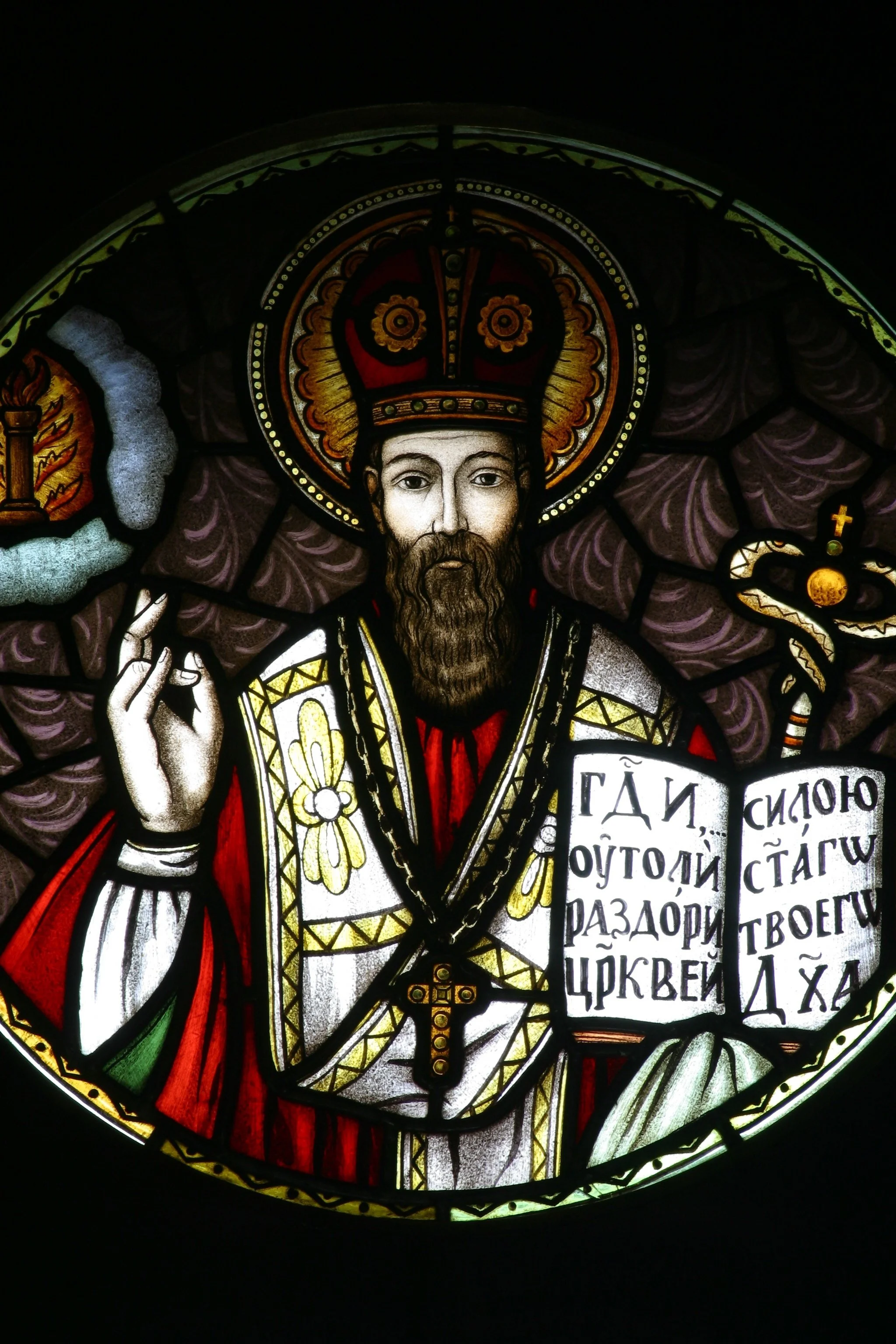
Stain glass of Saint Basil the Great
References
If you want to learn more about Saint Basil, here are some helpful references.
Primary Historical Sources
These are the most important documents, written by his family and peers in the 4th century.
St. Gregory of Nazianzus, Oration 43 (Funeral Oration on the Great Basil): This is the definitive biography of Basil, detailing their friendship, their time in Athens, and Basil’s death.
St. Gregory of Nyssa, The Life of St. Macrina: This text provides the details regarding Basil’s siblings, the death of his brother Naucratius, and Macrina’s spiritual influence on the family.
St. Basil the Great, The Letters: A collection of over 300 letters written by Basil himself, which detail his struggles with the Arian heresy and his daily life as a bishop.
St. Basil the Great, De Spiritu Sancto (On the Holy Spirit): The primary source for his theological defense of the Trinity.
St. Basil the Great, The Long and Shorter Rules (Asketikon): The source for his monastic philosophy and his transition from the "Desert Father" model to communal living.
Liturgical and Canonical References
These sources define how he is recognized by the Churches today.
The Roman Martyrology: The official list of saints recognized by the Catholic Church (records his feast on January 2).
The Orthodox Menaion: The liturgical book containing the lives of the saints for the Eastern Church (records his feast on January 1).
The Divine Liturgy of St. Basil the Great: The ancient text of the prayer service still used by millions of Christians today.
Historical and Academic Surveys
For the broader context of his "celebrity" status and the "Basiliad."
The Nicene and Post-Nicene Fathers (Series II, Vol. VIII): The standard English translation of his works and the accounts of his life.
"The Cappadocians" by Anthony Meredith: A scholarly look at how Basil, Gregory of Nyssa, and Gregory of Nazianzus reshaped Christian thought.
The Catholic Encyclopedia / The Orthodox Church (Timothy Ware): Used for verifying the shared status of saints and the history of the Great Schism.
Peddling
As a reminder there is a chance that I will be paid for any link that is clicked. The first few links are books. The last few are icons and medals. And a tote bag.
On the Holy Spirit: St. Basil the Great (Popular Patristics, 42) by Saint Basil
The Complete Works of Saint Basil (5 Books): Cross-Linked to the Bible by Saint Basil
ST. BASIL THE GREAT NOVENA FOR WISDOM (FILIPINO PRAYER BOOKS Book 20) by FILIPINO PADOVESE (Author)
Attend to Yourself: Saint Basil's Path to Inner Holiness by Saint Basil the Great (Author), Thomas Vasilakis (Translator)
The Monastic Rule of Saint Basil the Great by Saint Basil the Great (Author), Nun Christina (Author)
Saint Basil and Saint Gregory: Brothers in the Spirit, Champions of Heavenly Wisdom by Joseph Freyaldenhoven
Saint Basil Wooden Greek Christian Orthodox Wood Icon Ornament - 87053 - Museum Icons by G.DeBrekht
Heartland Store Men's Pewter Oval Saint Basil the Great Medal + USA Made + Chain Choice
Realig St Basil The Great Christian Round Medal Gold Tone Pendant with Rhinestones
Thank you again for reading this. I am praying for you. I ask that yo pray for me.
